Where ?: Haigslea Uniting Church Hall, 765 Thagoona-Haigslea Road, Haigslea Qld 4306 (opposite Haigslea State Primary School)
When ?: Tuesday evenings – 5pm to 6:30pm – Commencing 6/2/18
How much does it cost ?: Attendance is by donation (you contribute what it’s worth to you to participate) There is no set fee.
What do I bring ?: Essential items – yoga mat, yoga block and water bottle. Optional items – yoga strap, yoga bolster or firm cushion.
Who’s the teacher ?: Your teacher will be Ken Oldham. Ken studied with the Yoga and Integrative Medicine Institute and is a 350 hour, level 1 yoga teacher accredited through Yoga Australia.
What do I do next ?: Just turn up 10-15 minutes before the start time (no booking necessary).
FAQ Question: I’m not very flexible, can I still do yoga? Answer: Absolutely… flexibility comes with practice, and the asanas (yoga poses) can be adapted to suit your current body condition (asana modification is a fundamental concept of Viniyoga).
Question: Isn’t yoga just for girls? Answer: No way! Yoga is for EVERYBODY… any age (8 to 80 and beyond), any physical shape, any fitness level, and definitely not gender specific. As a matter of fact some very elite, high level football teams practice yoga as part of their regular fitness programmes.
At the beginning of October this year, a journalist from SBS Radio in Melbourne contacted me for an interview over the phone about Yoga.
It’s for SBS Radio the German speaking program. The segment within the German program is in Swiss – German (my first language), the weekly program on a Sunday night is called Echo Helvetia: interviews, portraits, stories, etc. about Swiss immigrants in Australia.
Yoga teaches us how to use the lungs to their maximum capacity and how to control the breath. Proper breathing should be deep, slow and rhythmical. This increases vitality and mental clarity.
Breath is life. We can live for days without food or water, but deprive us of breath and we die in minutes. In view of this, it is astonishing how little attention we pay in normal life to the importance of breathing correctly. To a Yogi there are two main functions of proper breathing: to bring more oxygen to the blood and brain: and to control prana or vital energy, leading to control of the mind.
What is proper breathing?
Breathing correctly means breathing through the nose, keeping the mouth closed, and involves a full inhalation and exhalation which bring the whole of our lungs into play. There are three basic types of breathing: clavicular (shallow), intercostal (middle) and abdominal breathing (deep). A full yogic breath combines all three, beginning with a deep breath into the abdomen and continuing the inhalation through the intercostal and clavicular area. Without lifting the shoulders. The abdomen fills, the chest rises. When we inhale, the abdomen expands and the diaphragm moves down, massaging the abdominal organs. When we exhale, the abdomen contracts and the diaphragm moves up, massaging the heart. In the beginning it is very helpful to place one hand on the abdomen, and the other one on the chest.
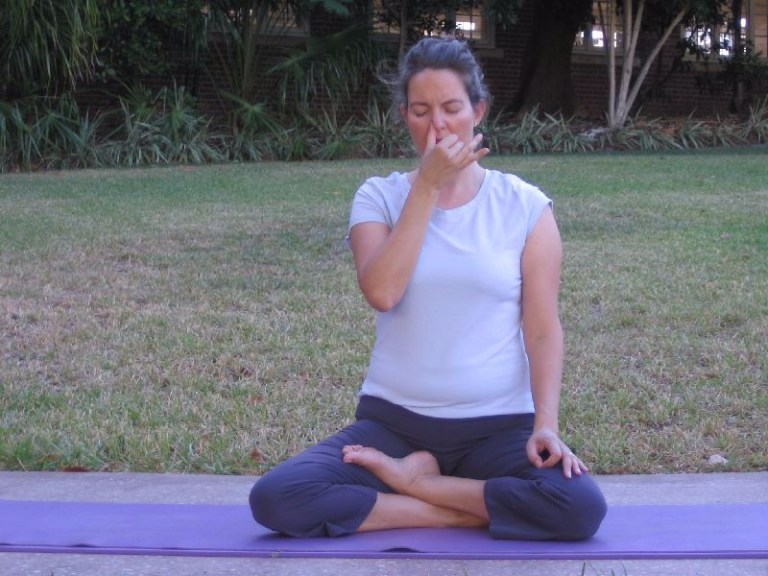
Pranayama literally means control of life force or vital energy. Prana=vital energy, yama=control.
Anuloma Viloma – the alternate nostril breathing is one of many yogic breathing techniques or exercises.
Our physical body is meant to move and exercise. If our lifestyle does not provide natural motion of muscles and joints, then disease and great discomfort will ensue with time. Proper exercise should be pleasant to the practitioner while beneficial to the body, mind and spiritual life.
Asanas or yoga postures/exercises focus on increasing and maintaining flexibility of the spine, toning and rejuvenating the nervous system. The gentle stretching, twisting and bending movements bring flexibility to the joints and muscles of the body, as well as massaging the glands and organs. Circulation is also improved, ensuring oxygen to all the cells of the body. The different poses put pressure on various points, which help to relax the nervous system and therefore also helps to release stress.
The Sanskrit word Asana means steady pose, therefore holding the yoga postures is beneficial. Taking a few deep breaths in every pose, slowing down.
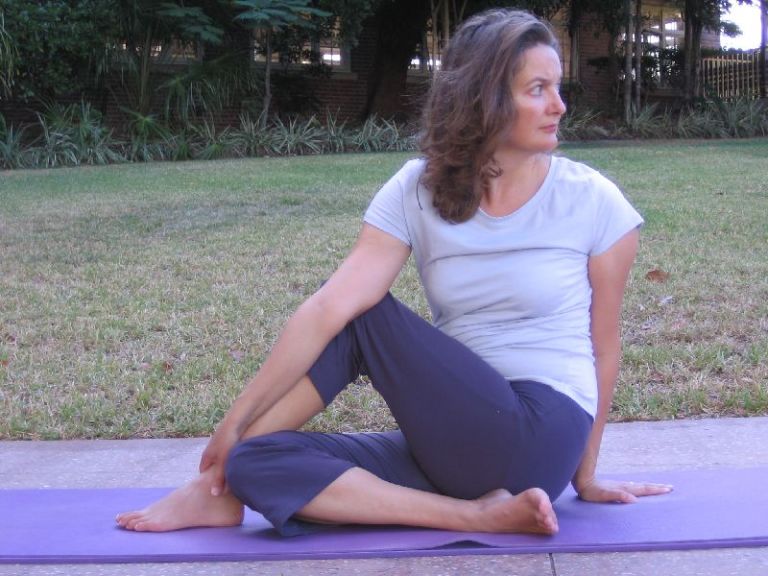
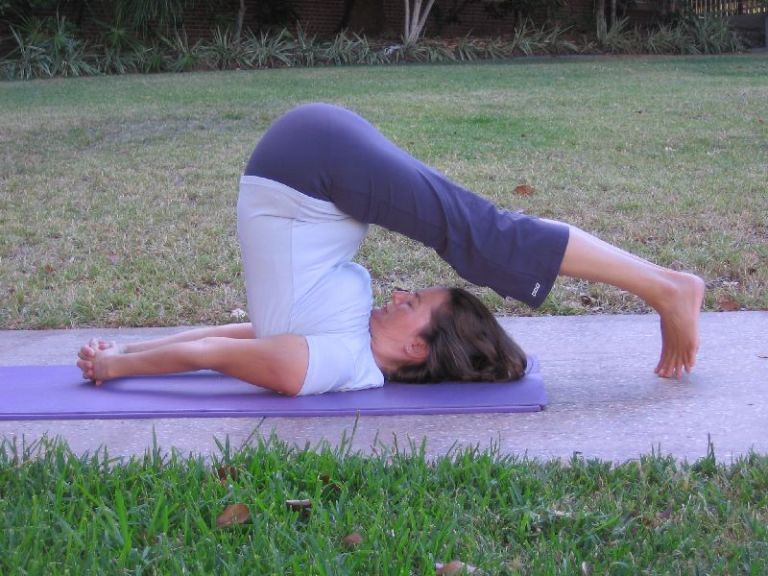
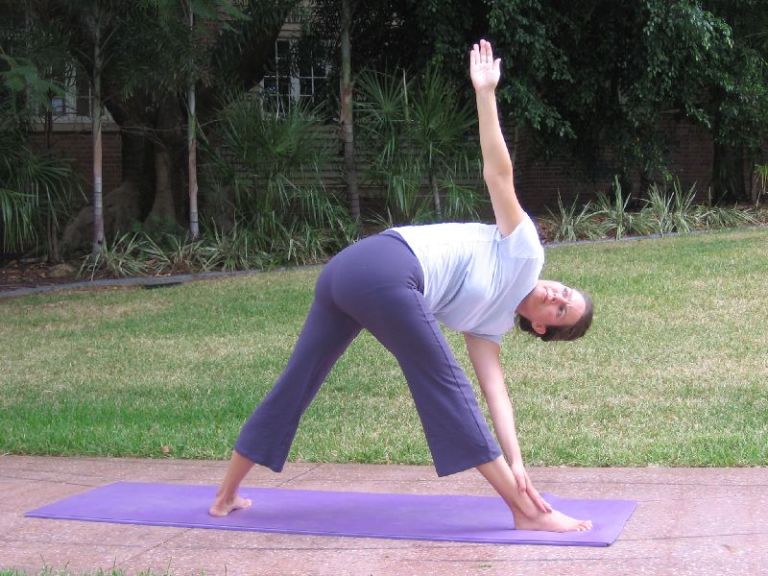
Ardha Matseyndrasana – half spinal twist.Halasana – the plough.Standing spinal twist in triangle – Parivritta Trikonasana.






 Hatha Yoga Ipswich