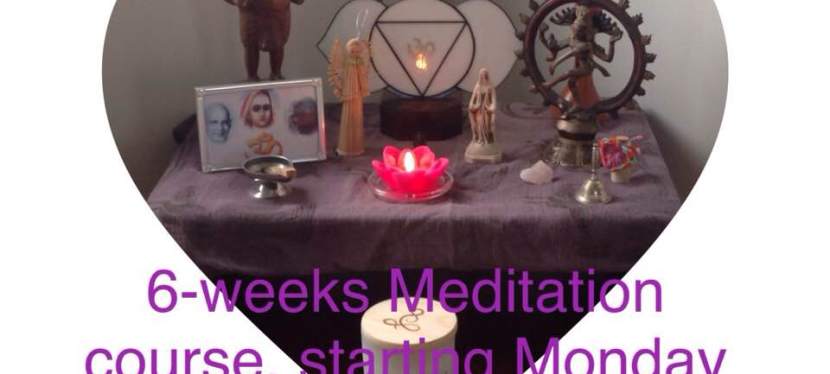
I’m teaching a meditation course starting Monday the 13th of May 2019, from 5pm – 6pm for 6 consecutive weeks.
The cost for the whole 6 sessions upfront is $80.-, if you prefer you can pay and attend each session individually $15.-
The course is based to learn step-by-step the Japa Meditation practice (repeating a Mantra as a focal point). But each week, has also it’s own, individual lesson. So in case you can’t commit to 6 weeks ahead of time, you are most welcome to join for a couple of lessons.
This meditation class is taken at our home in Silkstone, and you need to book and confirm please.
What to expect from this meditation course:
Besides and as preparation for the Meditation, we’ll do light stretches, breathing techniques, concentration exercises and learn about the purpose of meditation.
It has been a while, since I offered a course like this. If you are interested, make some time to attend all six weeks or a few lessons.
How I recently experienced the power of proper breathing.
Healing on and by the water. Tallebudgera Creek, November 2018. Photo by Prema Maria
A couple weeks ago I had a root canal treatment. It wasn’t my first one ever. But for this one, I had to go to an Endodontist, a specialist for those kind of procedures. I spare you of the details.
The procedure took about two hours. I couldn’t do much, lying there with my mouth open, breathing through the nose.
And that’s exactly what I’ve done. I had my hands on my belly, focusing on deep abdominal breathing, taking the attention and focus away from my face. While I visualised healing light all around me, specially on my tooth, as well as for the Endodontist and Assistant. They did the hard work, I was just lying there.
Now in general I very seldom meditate for longer than 15 minutes. But I had no other choice, no place to go – nothing to do. I tried to detach from my body and observe myself from the outside. Forgetting time and space.
Of course I felt dizzy and was numb on one side of my face, once the procedure was finished. Instead of going home or trying to drink, let alone eat anything. I went straight to the movies. Probably the best I could do at the moment, and I can highly recommend it. I watched “A Star is born”. It made me forget my tooth, I was distracted in a dark room. While the sensation in my face and mouth came back slowly. Afterwards I drank a green smoothie with a straw and went home on the train.
In the evening I was teaching a yoga class, without bending forward or moving my head too much.
At night before going to sleep I took two pain-killers, just in case it would help me from waking up through the night with pain. Plus I did not need to be a hero, as I almost never take any painkillers.
The next morning I had the day off. I could feel the pain and swelling ease by the hour. I was thinking more about the movie I saw, listening to the Soundtrack of “A Star is born”, than my tooth.
I give credit to my almost pain-free experience and quick healing to the BREATH, proper deep abdominal yoga breathing, meditation of detaching from the body.
Everyone in my yoga classes the following week, had to listen to my story. As I was practising and experiencing in every day life, what I preach.
Thank you for reading my story !! Prema Maria
PS: In addition to the breathing exercise, I would recommend to go straight to a movie theatre after a root canal treatment or similar.
Tallebudgera Creek, a few days after the procedure we had a nice Sunday on the stand-up-paddle boards on Tallebudgera Creek. November 2018, Photo by Prema Maria
Besides being responsible for building our physical body, the foods we eat profoundly affect our mind. For maximum body-mind efficiency and complete spiritual awareness, Yoga advocates a lacto-vegetarian diet. This is an integral part of the Yogic lifestyle.
The yogic diet is a vegetarian one, consisting of pure, simple, natural foods which are easily digested and promote health. Simple meals aid the digestion and assimilation of foods. Nutritional requirements fall under five categories: protein, carbohydrates, minerals, fats and vitamins. One should have a certain knowledge of dietetics in order to balance the diet. Eating foods first-hand from nature, grown in fertile soil (preferably organic, free from chemicals and pesticides) will help ensure a better supply of these nutritional needs. Processing, refining and overcooking destroy much food value.
There is a cycle in nature known as the “food cycle” or “food chain”. The Sun is the source of energy for all life on our planet; it nourishes the plants (the top of the food chain) which are then eaten by animals (vegetarian), which are then eaten by other animals (carnivores). The food at the top of the food chain, being directly nourished by the Sun, has the greatest life promoting properties. The food value of animal flesh is termed as “second-hand” source of nutrition, and is inferior in nature. All natural foods (fruits, vegetables, seeds, nuts and grains) have, in varying quantities, different proportions of these essential nutrients. As source of protein, these are easily assimilated by the body. However, second-hand sources are often more difficult to digest and are of less value to the body’s metabolism.
Many people worry about whether they are getting enough protein, but neglect other factors. The quality of the protein is more important than the quantity alone. Dairy products, legumes, nuts and seeds provide the vegetarian with an adequate supply of protein.
A healthy motto is: “Eat to live, not live to eat”. It is best if we understand that the purpose of eating is to supply our being with the lifeforce,or Prana, the vital life energy. So the greatest nutritional plan for the Yoga student is the simple diet of natural fresh foods.
However, the true Yogic diet is actually even more selective than this. The Yogi is concerned with the subtle effect that food has on his mind and astral body. He therefore avoids foods which are overly stimulating, preferring those which render the mind calm and the intellect sharp. One who seriously takes to the path of Yoga would avoid ingesting meats, fish, eggs, onions, garlic, coffee, tea (except herbal), alcohol and drugs.
Any change in diet should be made gradually. Start by substituting larger portions of vegetables, grains, seeds and nuts until finally all flesh products have been completely eliminated from the diet.
The Yogic diet will help you attain a high standard of health, keen intellect and serenity of mind. To really understand the Yogic approach to diet one has to get familiar with the concept of the 3 Gunas * or qualities of nature.
*(I’ll explain the 3 Gunas in a future post)
I eat and thrive on a vegetarian diet since many years, including raw vegan.
Quinoa salad, zucchini fritters, roasted vegetables with yogurt dressing + and raw vegetables / mixed salad with avocado dressing.
Vegetables from my garden: sauteed greens (silverbeet+spinach), rocket or rucola, cherry tomatoes and homemade sauerkraut.
Raw Vegetable plate at my sister’s place in Switzerland, made with organic vegetables fresh from the farmers market.
The weekly Yoga class at the PCYC Ipswich is continuing as well. Silvia will teach this class, Wednesdays 6:30pm – 8pm. Please contact the PCYC Ipswich for cost and terms. http://www.pcyc.org.au/ipswich/
Our physical body is meant to move and exercise. If our lifestyle does not provide natural motion of muscles and joints, then disease and great discomfort will ensue with time. Proper exercise should be pleasant to the practitioner while beneficial to the body, mind and spiritual life.
Asanas or yoga postures/exercises focus on increasing and maintaining flexibility of the spine, toning and rejuvenating the nervous system. The gentle stretching, twisting and bending movements bring flexibility to the joints and muscles of the body, as well as massaging the glands and organs. Circulation is also improved, ensuring oxygen to all the cells of the body. The different poses put pressure on various points, which help to relax the nervous system and therefore also helps to release stress.
The Sanskrit word Asana means steady pose, therefore holding the yoga postures is beneficial. Taking a few deep breaths in every pose, slowing down.
Ardha Matseyndrasana – half spinal twist.
Halasana – the plough.
Standing spinal twist in triangle – Parivritta Trikonasana.
You can join for both sessions to get most benefits, a good way to end the working week. Or if this is not possible for you, just attend the Hatha Yoga class or the Satsang/Kirtan class.
In between the two sessions we have a cup of tea and something sweet.
If you know you will be coming for sure, please let me know (message, email or in class). Otherwise it is perfectly fine to just show up and bring your friends.
Looking forward to a yogic start into the weekend. OM OM OM